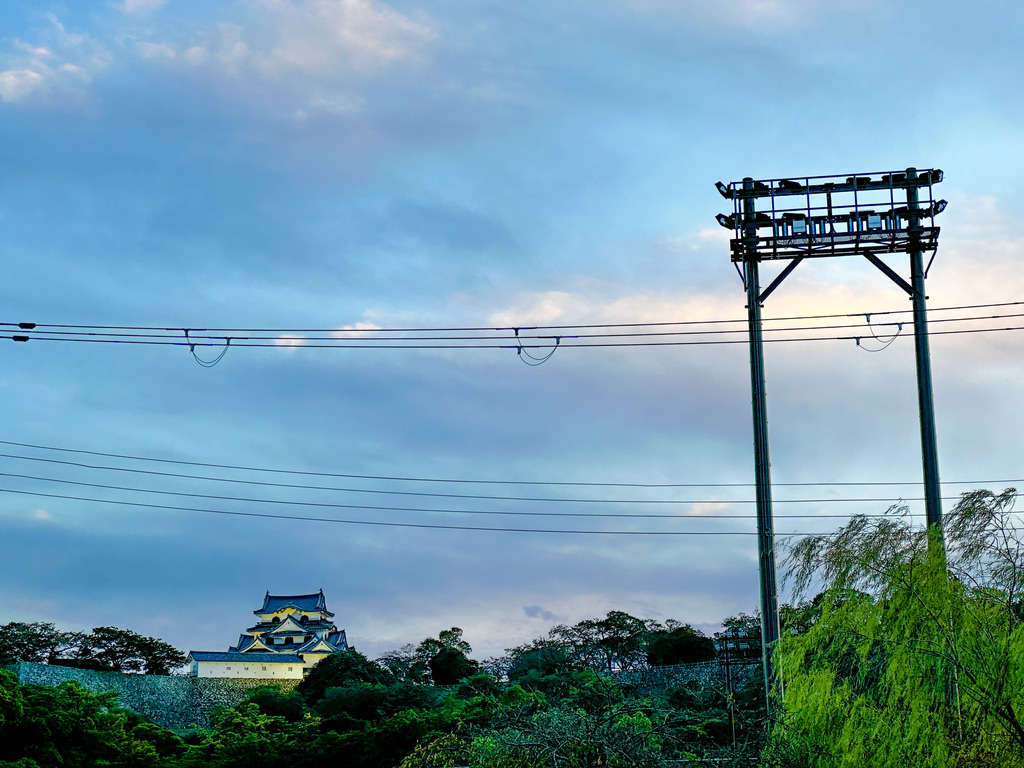
Hating cities doesn't make you trad, it makes you a Gnostic. Yes cities are bad, but we cannot easily say cities are inhuman, if anything they are ultra-human1, point being, cities are made by humans expressing their human nature, now, the question then becomes, what is 'their' human nature, and how does it conflict with those who are not drawn to urbanity?
Then we must also ask, simply, what is 'bad' about cities? And why do some cities in the world, namely Japanese ones2, not have that same feeling? Is it simply Orientalism? I think that is an easy answer, however the existence of 'ensouled' cities outside of Japan breaks this hypothesis.
The truth is, Japan simply the only modern Animistic country from the world, whose culture is not modern but is rather Bronze Age. Look to the old Prophets like Abraham and Akhenaten3, what do they share in common? I think it is obvious, is it not? They both rebel against an urbane population who no longer understands that the many and one are the same, in both cases as well, Abraham and Akhenaten destroy all the idols, and enforce worship of the one. Yet, what causes this? We must take these traditions and their stories at face value, these are real humans, and real humans who, clearly, had a lot of people who also believed them. In King Akhenaten's case his legacy was swiftly destroyed, only to be rediscovered in modernity, but for Abraham it was something uniquely different, he was no King, nor even a Priest, he was a heretic, the heretic Prophet of those who saw the calamity in Ur and understood there was something better.
Abraham did not stay in Ur to fix things4, he left Ur, to go found Zion, and create the people of Israel.
Yet what they did is not simply an anarcho-primitivist life, no, rather they tried to create their own society under their own values, stewarded by their God of Israel, and it is this very act that every single Old Testament forward Judeo-Christian whether they be Hacidic or Amish, try to reemulate. Even the Amish themselves are not true anarcho-primitivists.
So what does this have to do with Japan?
I argue that Japan, being an animist country that is bronze age in all but technology, has uniquely understood something that we Judeo-Christians culturally have not, and from observing and learning from them, we can learn to emulate their ideals ourselves.
Everyone with a soul knows, Tokyo is no ordinary city5, the Gods sing and are alive there. Yet, the same cannot be said for many other cities in the West, you might find soulfulness but it is against the city, it is in opposition to the city, this makes sense, no? Yet, we do not find this in Tokyo. We don't find this in many cities of Japan. You may come across a city with this feeling in the West yet it will always be a smaller city, a town even, and the town will likely be all of one specific religion, faith, or congregation. This is not a coincidence!
Yet how does Japan manage to do it, with the largest city in human history? I've point to it many times. They are animist! Of course, but how is this different? Because there is no duality sitting in their mind, latently. Don't mistake this as me saying their religion or culture makes the cities nice magically, no, I am not saying that at all. Rather, that without the duality of Judaism sitting in the depths of their minds, they do not have any intrinsic revulsion at the city, they see it as something that humans do, and something that sometimes humans -must- do, the history of Tokyo the 'new capital' of Japan turned largest city on Earth tells us this very explicitly.
In the West we reject this, we see the city as a necessary evil, a means to an end, or worse we see it as a pile of corpses that we will built upon to greet God sabre and shot first, but I think both of these are wrong. Humans contain diversity, and this diversity is what makes us powerful, all humans fall into specific niches, and alone in their niche they fall into a state of dreamlike nightmare, whereas in the inverse the specialized unspecialized folk of cities fall into a state of manic daymare. Neither of these really happen in Japan. Now hold up, you might say "Wait but isn't there all this media in Japan depicting this?" Well, yes, because it is unique, it is novel, it is worth making art about. Someone killing themselves because they lost their job is not worth making an entire series in America, that is life, and every office is made out of bones and littered with living and undead ghosts, this is the inspiration for the 'Backrooms'6.
The Western mind is obsessed with liminality, but liminality has two forms, the Judeo-Christian kind, and the 'Oriental' kind (Perhaps call it Dharmic, though that negates the Daoist aspect which is crucial). The Judeo-Christian kind is the one that you and I know well, Graveyards are a wonderful liminal space in the Western imagination because they represent the boundary between the Material and the Immaterial. How does a society that so thoroughly rejects dualism see a Graveyard? Not as a liminal space, I'll tell you that much.
Liminal spaces appear in the forest of the mind for the Oriental, not in the forests of the trees. Think of the Japanese film Perfect Blue7 for an example of this.
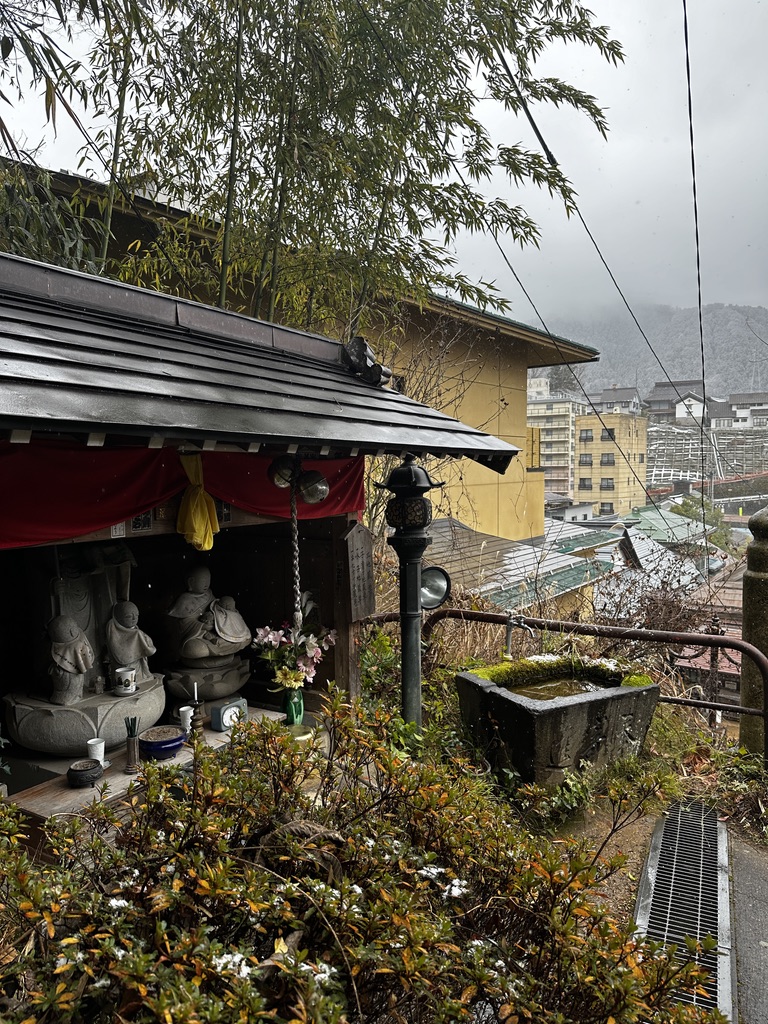
Wander into a Japanese city and go off the beaten path8, you will come across a shrine, not a tourist shrine (though even those are ensouled) but just a simple shrine. You will feel a sense of peace, you will see the Bodhisattva or the Kami9, you will see his flaming sword, his crown of fire, his warm smile, his enlightened belly, and you will look around, and see concrete, wood made inanimate, humanity in all her myriad forms, and you will not feel the same as you might in a big Western city.
Here, you feel a sense of calm, because every shrine is a reminder of impermanence, it is a reminder that humans are apart of nature, we do not destroy nature, and nature does not destroy us. We are not apart from nature, we are nature, and everything we do is natural. This does not mean to be cruel and wanton with nature, far from it, for God in her wisdom has imbibed us with the succor of wisdom, and with that, we must be mindful.
For the Judeo-Christian their form of mindfulness is duality, the Human World vs the Natural World, the world of Adam and Eve and the Fallen World they inherited for their sins, the world of the Demiurge10 and his wicked Yaldaboathian treats11 opposed to the pure trascendental ambrosia of the perfect God in Oneness. All of these are false delusions, for the 'Oriental' perception is far from 'Oriental', it is simply the natural state of man, and the Orient is simply lucky enough to not have this bodhichitta terminating philosophical parasite infect their minds in complete totality, and thus infect her civilizations and her peoples.
So yes, we should reject the West, we should reject Western urbanity, but we should reject it not for the sake of its urbanity, for from the Shinto we can see, urbanity can indeed be ensouled, if only we do not see ourselves as ecologically separate from the world surrounding us, if only we stop seeing the world as something that surrounds us and rather something that we exist in like a fish exists in water.
If we want to have beautiful cities in the future where the Gods sing, we cannot simply abandon our civilization and become Japanese, we are not Japanese, but we must look at them as the only true and authentic Animist country in the world, and we must see the ensouled and enlivened cities of Japan as proof that cities are themselves not inherently bad, they are only bad when man sees himself as separate from the land upon from which cities are built.
Next time you are just in Japan in a city, find the most inhuman area possible, like Shibuya or Akihabara. Just wander around, walk down alleyways, find the hidden pedestrian paths, and you'll find one of those little shrines. Take note of it, see how you feel there. The spirits of a land are always present, always real, and always sociable, why else do you think the American spirits seem so enraged compared to even those in Europe? Yes European cities suffer from the same issue American ones do, but uniquely, the rural parts of Europe don't! Travel around all of the Alps and no matter if you're in France, Germany, Switzerland, Italy, or Austria, you'll find little shrines everywhere12. These shrines matter, because they show that the people there, in SPITE of their Judeo-Christian cultural heritage, still understand deep inside, that they and the land around them are not separate. Their cities are devoid of this wisdom, but the country folk still remember, have we forget what the actual meaning of Pagan and Heathen13 are...?
If one only saw the European and American examples, one would conclude Pagan and Heathen are true, to be truly Pagan one must be rural, yet I think Japan shows us greatly that this is not true, you can be an ensouled Pagan country, with Pagan cities larger than humanity has ever known, and the Gods like Bonten14 and Fudomyoo and Benzaiten15 and all the kami of the land will walk with you, and sing in harmony, they will sing Hallelujah!
We can have this, if only we see that it is possible. If only we reject this latent gnosticism hiding deep within our minds, if only we stop seeing cities as themselves evil, and accept that cities are simply fallen, that their inhabitants simply have forgotten the old ways, they've forgotten what bestows the Mandate of Heaven16. We can have a New York City and a San Francisco 10x as big as they are now, but filled and enlivened with the spirits of the land, with denizens who know God, who know that God and the Gods walk all around them, who know that cities themselves are impermanent, and that the shrine to Buddha next to the skyscraper will be here when the skyscraper is gone, because the land does not ask for the skyscraper, but it does ask for the shrine, and so long as humans have an ear to hear, they will walk the same land, listen to her calls, and build a shrine where a shrine should be.
Everything returns to ash, but humanity lives on through every ruination. Never forget that. Man is Nature, Man is made in God's image, which is Nature17. The only inhuman belief is the idea that man and nature are oppositionary forces.